The 20-yard sits between the 15-yard and the 30-yard Mammoth Dumpster Rental runs five roll-off sizes: the 10-yard at $595, the 15-yard at $650, the 20-yard at $695, the 30-yard at $795, and the 40-yard at $895. The…
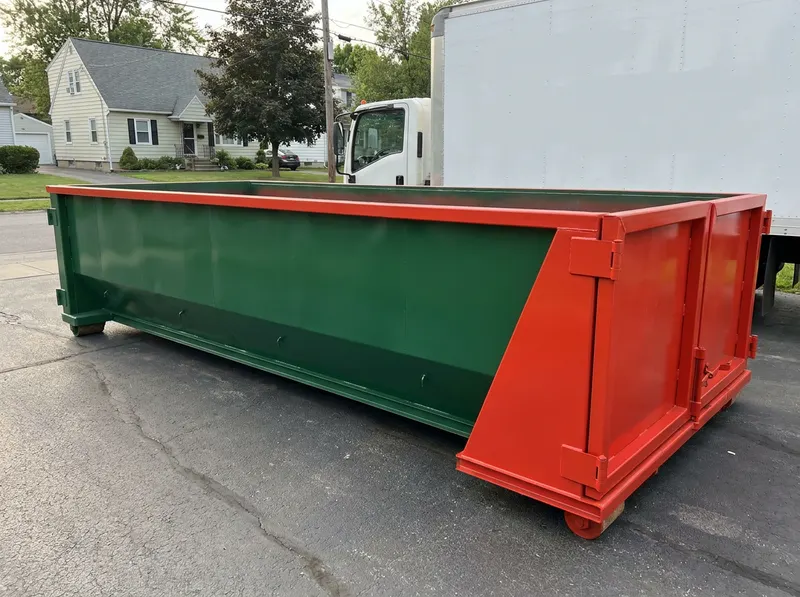
Mammoth Dumpster Rental runs five roll-off sizes: the 10-yard at $595, the 15-yard at $650, the 20-yard at $695, the 30-yard at $795, and the 40-yard at $895. The 20-yard holds about 20 cubic yards, roughly 8 pickup-truck loads, or double the 10-yard's ~4 loads. Its 4.5-foot walls are low enough to toss drywall and shingles over the side without a walk-in door, which separates it from the taller 30- and 40-yard bins used for full tear-outs.
If a single room or a two-car garage is coming apart, the 20-yard is the usual fit; if an entire house is being gutted, the 30-yard carries more volume without a second haul.
Decision-fit in plain terms: a kitchen or bathroom remodel in an Elmwood Village double, a basement cleanout in North Park, or a mid-size roof tear-off in South Buffalo all land squarely in the 20-yard. A single-room declutter leans toward the 10- or 15-yard; a whole-estate cleanout in University Heights or a full home gut in Kaisertown leans to the 30-yard. The trade-off is driveway footprint against debris volume, a 20-yard needs about 22 feet of clear run plus room for the truck to lift it, while a 30-yard needs the same length but holds half again as much.
A dumpster rental is self-load: the bin is dropped and you fill it, which is different from waste management services where a crew removes items for you.
Placement matters on Buffalo's older streets. Many Allentown and Black Rock lots have narrow shared driveways, so boards are laid under the rollers to protect the surface, and the bin is positioned to keep the lid and curb clear. A dumpster set on a public street, common on tight blocks in Riverside, Lovejoy, and Kenfield, may require a right-of-way permit from the City of Buffalo; one placed entirely on private property usually does not.
Erie County transfer sites follow New York State DEC recycling and disposal rules, which is why certain materials cannot ride in the bin.
Prohibited items are listed up front: no wet paint, no automotive fluids, no tires, no batteries, no appliances containing refrigerant, and no household hazardous waste. Refrigerants fall under the federal Section 608 refrigerant rules, electronics under EPA e-waste guidance, and tires and appliances are handled through separate recycling streams rather than the landfill. On roofing jobs, mixing shingles with heavy masonry can overload a bin, so OSHA roofing safety load limits and even weight distribution keep the container legal to haul.
Yard waste and clean wood are often diverted toward composting and organics rather than disposal, and leftover building materials can sometimes be checked against local recycling directories before they hit the bin.
Every job gets a firm, written price after an on-site visit.
Tell us about your 20-yard dumpster rental job in Buffalo and we'll send a clear, written quote, usually the same day.
 Mammoth Dumpster Rental